
The chart says G. The singer says it sits too low, and the gig is on Friday. Transposing is the fix, and it is less work than it looks: find the key that suits the voice, count the distance, and move every chord by that same distance. This guide walks through each step, with a chord table and a capo chart you can use on the spot.
1. Find the key that suits the singer
Do not start from the chords. Start from the voice. The part that decides the key is usually the highest phrase in the chorus, or the lowest note in the first verse if the singer struggles down there.
- Play the chorus in the original key and ask the singer to sing it at full volume, not half-voice.
- If it strains, move up or down one or two semitones and sing it again. Record each try on your phone; it is easier to judge afterwards than in the moment.
- Pick the key where the high notes are strong and the low notes are still audible. That is the target key.
When a song moves between a male and a female voice, the change is often bigger than two steps. Somewhere around a fourth or a fifth (5 to 7 semitones) is common, but the only reliable test is singing it.
2. Count the distance in semitones
Write out the twelve notes and count steps from the original key to the target key:
C - C♯/D♭ - D - D♯/E♭ - E - F - F♯/G♭ - G - G♯/A♭ - A - A♯/B♭ - B
From G to A is 2 semitones up. From G to F is 2 down. From C to E is 4 up. Going up 7 lands on the same notes as going down 5, so pick whichever direction is shorter or gives easier chords.
3. Move every chord by the same distance
Each chord root moves by the number of semitones you counted. Everything after the root stays the same: a minor chord stays minor, a 7 stays a 7, sus4 stays sus4.
| Original (G) | Up 2 (A) | Down 2 (F) |
|---|---|---|
| G | A | F |
| Em | F♯m | Dm |
| C | D | B♭ |
| D7 | E7 | C7 |
| D/F♯ | E/G♯ | C/E |
Three details trip people up:
- Slash chords move twice. In D/F♯ both the chord and the bass note move, so up 2 it becomes E/G♯, not E/F♯.
- Sharps or flats. A♯ and B♭ are the same note, but in the key of F nobody reads A♯. Keys like F, B♭, E♭ and A♭ are written with flats; G, D, A, E and B with sharps.
- Key changes inside the song. If the last chorus goes up a step, it goes up a step in the new key too. Move it by the same distance as everything else.
4. Or keep the shapes and use a capo
On guitar you can often skip rewriting the chart. Keep playing the shapes you know and put a capo on: every fret raises the sound by one semitone.
| Shapes you play | Capo 1 | Capo 2 | Capo 3 | Capo 4 | Capo 5 |
|---|---|---|---|---|---|
| C | D♭ | D | E♭ | E | F |
| A | B♭ | B | C | D♭ | D |
| G | A♭ | A | B♭ | B | C |
| E | F | F♯ | G | A♭ | A |
| D | E♭ | E | F | F♯ | G |
So if the singer wants A and you know the song in G shapes, capo 2 does it. A capo only goes up, though. If the singer needs the song lower than your shapes, you have to change shapes (or retune).
One thing to agree on with the band: the guitarist with a capo reads G shapes, while the keyboard and bass need to see A. Two different charts for the same song is where most rehearsal confusion starts.
5. Transpose a whole chord sheet in seconds
Counting by hand is fine for four chords. For a full song with a bridge, slash chords and a key change, let a tool do it:
- The free MeloRep Chord Transposer takes a pasted chord sheet or a ChordPro song, moves every chord to the key you pick and keeps the chords above the right words. No sign-up.
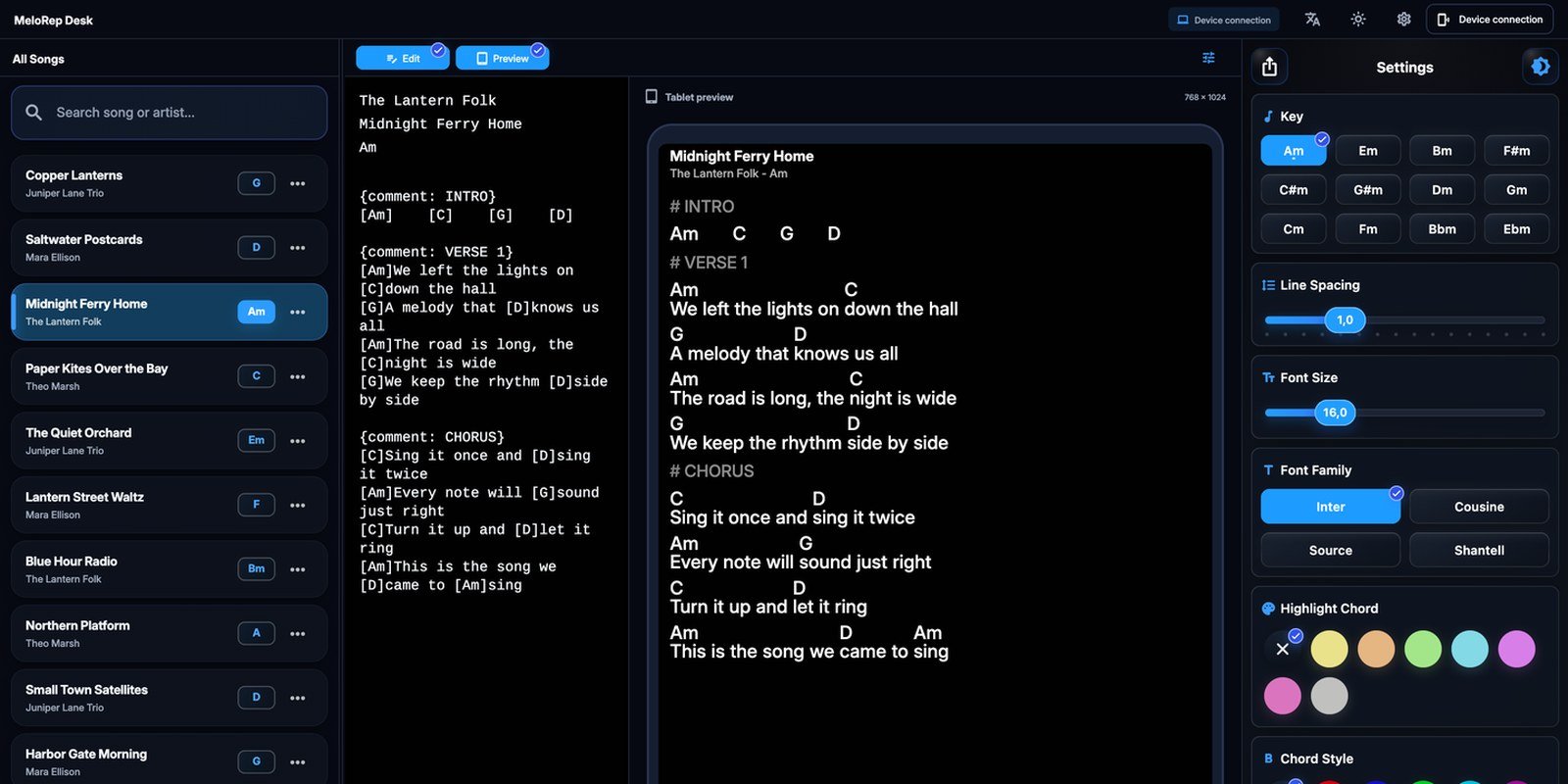
- In the MeloRep app, open a song, tap the gear and pick a key from the grid. If you opened the song from a set, the new key is saved for that set only, so the same song can be in G for one singer's set and in A for another's.
- To change the song itself, use Transpose in the song editor on the whole song or just the selected lines.
- With MeloLive, band members follow the leader's screen and can set their own transpose. The guitarist can read capo shapes while the keyboard player reads concert pitch.
Bands that think in numbers can also switch the chart to the Nashville Number System (1-4-5 or I-IV-V). Then the chart stays the same in every key and only the singer's key changes.
Quick answers
Does transposing change the melody?
No. Every note moves by the same amount, so the melody, harmony and feel stay the same. Only the pitch changes.
How do I know if I should go up or down?
If the high notes strain, go down. If the low notes disappear, go up. When both happen, the song's range is wider than the voice, and a different arrangement helps more than a new key.
Can I transpose a ChordPro file?
Yes. The chords in square brackets move and the lyrics stay put. Both the free tool and the MeloRep app read ChordPro.